
 Made in the Netherlands
 Free product of your choice with orders over €75,-




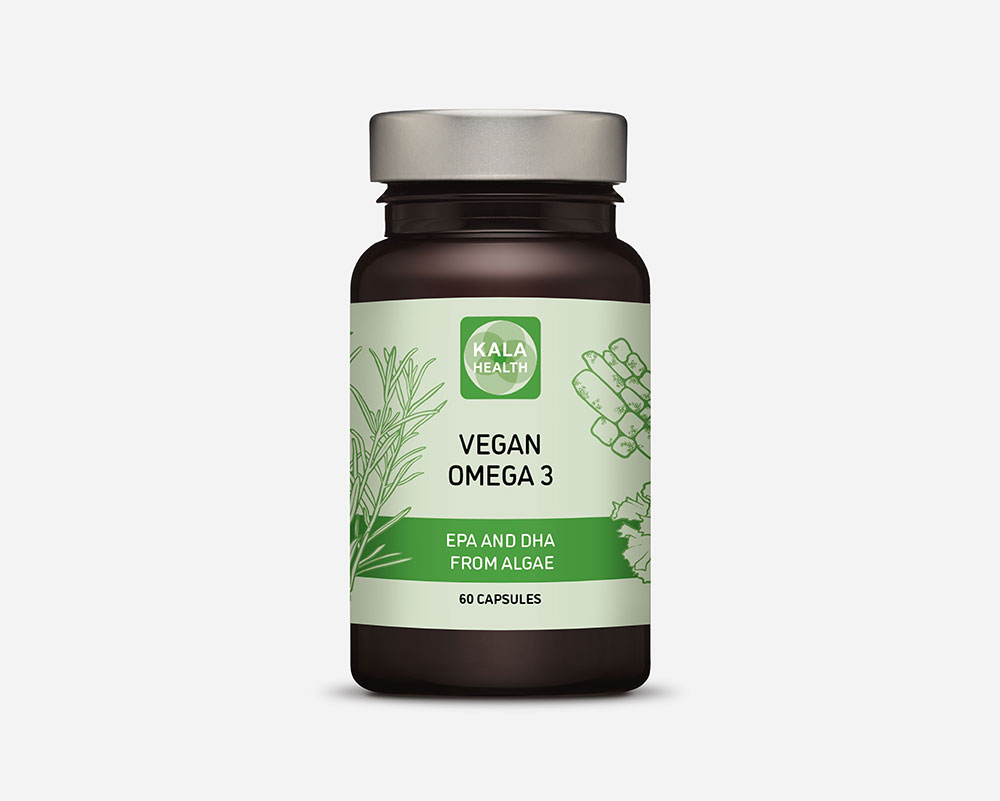
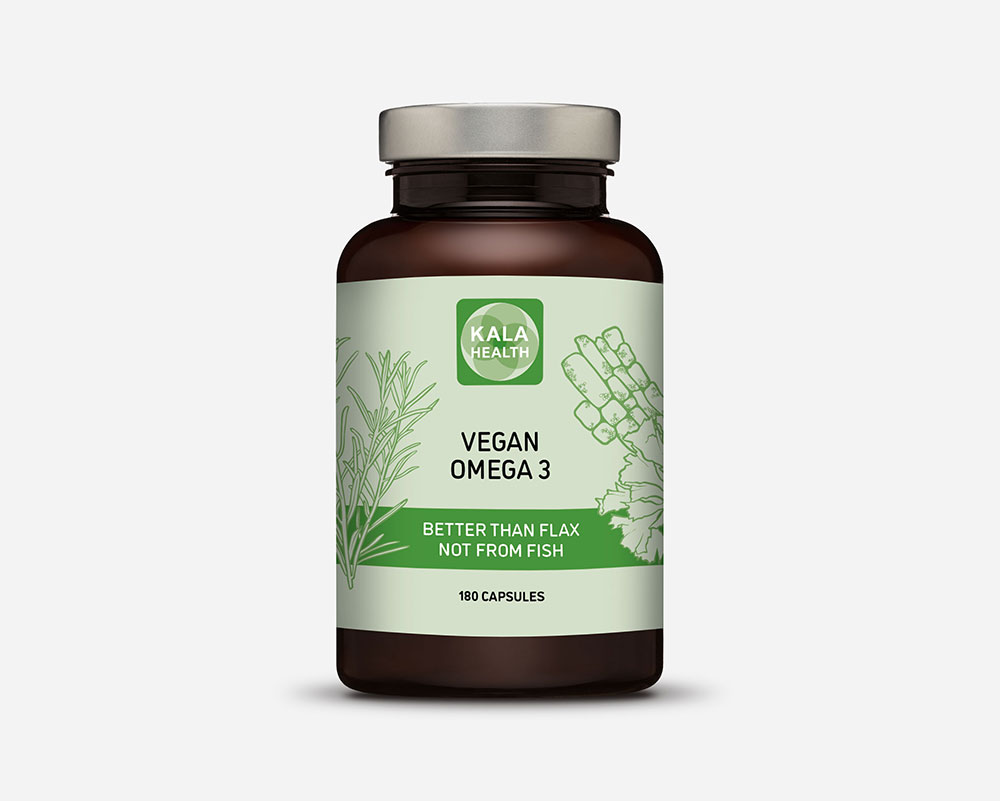
Vegan Omega 3
- Sustainable and better than fish oil: Rich in omega-3 fatty acids of plant origin and no longer dependent on overfishing.
- The solution for vegans and vegetarians: Vegan omega-3 is 100% vegan with plant-based capsules.
- Vegan omega-3 – Superior formula compared to other plant-based oils: Since the vegan Algae Oil (Schizochytrium sp.) is rich in EPA and DHA, there is no need for the conversion of fatty acids ALA and SDA to EPA and DHA.


Description
Vegan Omega 3
A sustainable alternative: DHA and EPA straight from algae.
✓ 250mg EPA & 750mg DHA per day ✓ extracted from Schizochytrium sp. ✓ Made in the Netherlands
Vegan Omega-3: DHA and EPA straight from algae
If you don’t eat fish, you’re missing a direct source of EPA (eicosapentaenoic acid) and DHA (docosahexaenoic acid): the two most important omega-3 fatty acids. Flaxseed, chia seeds and walnuts also contain omega-3, but in a different form, ALA (alpha-linolenic acid), which your body struggles to convert into EPA and DHA. Vegan Omega 3 skips that conversion step: the EPA and DHA come straight from algae, the same source fish originally get it from too. 100% plant-based, without fish, without overfishing or bycatch.
The conversion of ALA into DHA and EPA is not effective
The body can convert ALA into EPA, and then into DHA, through a few enzymatic steps. That sounds like a solution, but in practice this conversion is limited.
Older estimates put conversion of ALA to EPA at around 8 to 12%, and to DHA at about 4% (Emken et al., 1994). More recent research using stable isotopes shows considerably lower figures: less than 0.1% conversion to DHA and less than 0.4% to EPA and DHA combined (Pawlosky et al., 2001; Hussein et al., 2005). Even a substantially increased ALA intake (more than seven times the recommended amount) showed no measurable rise in DHA in research (Burdge et al., 2002).
This means relying on ALA alone is not a reliable route to getting enough EPA and DHA. That’s precisely why this supplement is made from algae oil that naturally contains EPA and DHA.
From algae tank to capsule
Fish don’t make omega-3 themselves, they eat algae, or eat fish that has eaten algae, and that’s how EPA and DHA enter the food chain. Algae oil skips that intermediate step and goes straight to the source: the microalga Schizochytrium.
This alga isn’t grown in the open sea, but in closed fermentation tanks, where it’s fed sugars instead of sunlight. Under controlled temperature and oxygen levels, the alga builds up a high fat content: often 40 to 60% of its dry weight, a significant portion of which is DHA (Guo et al., 2018). After cultivation, the oil is extracted from the algae cells by centrifuging and pressing, and then purified.
What sets this Vegan Omega 3 apart
Many algae oils on the market typically contain almost exclusively DHA and hardly any EPA.
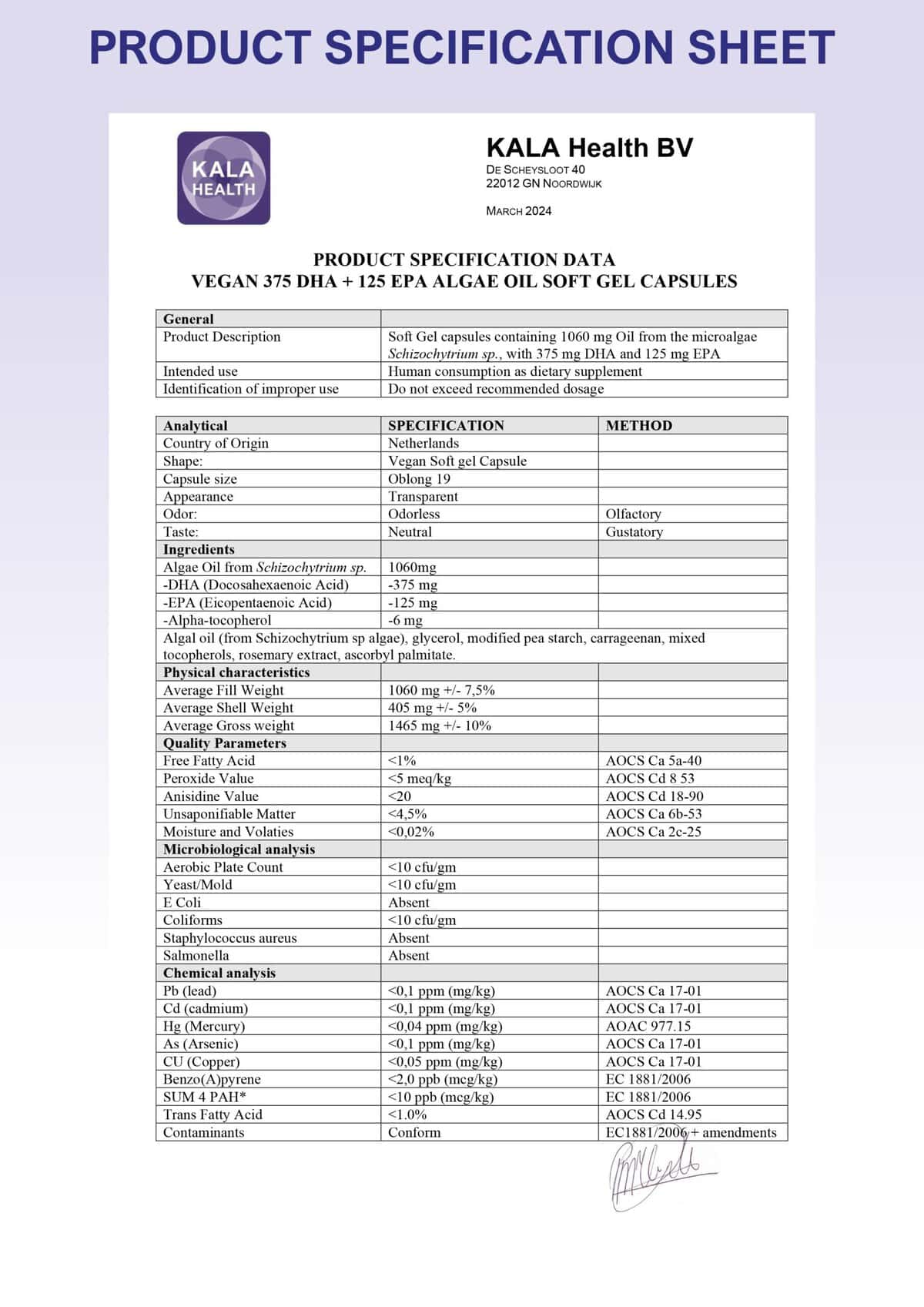
Ours contains both: alongside 375 mg DHA, also 125 mg EPA per capsule (Zhang et al., 2025).
Why choose vegan omega 3?
Fish oil production is associated with overfishing and bycatch, and contributes to the depletion of marine ecosystems. Commercial fish farms also often rely on fishmeal and antibiotics.
This year and next, additional factors have come into play. Due to a warming seawater pattern (El Niño) off the coast of Peru, which accounts for around 20% of global fishmeal production, the anchovy quota for 2026 has been cut by more than a third, to its lowest level in ten years. As a result, fish oil suitable for supplements has become significantly scarcer and more expensive.
Our algae oil is grown in closed tanks, independent of the weather or the state of the ocean, and therefore independent of overfishing and bycatch too. By choosing algae oil as your source of omega-3, you’re making both an environmentally conscious and a pure choice.
Health benefits of EPA and DHA
The omega-3 fatty acids EPA and DHA support the body in several ways. The following health claims are approved within the European Union:
- EPA and DHA contribute to the normal function of the heart (at a daily intake of 250 mg EPA+DHA)
- DHA contributes to the maintenance of normal vision and normal brain function (at a daily intake of 250 mg DHA)
Our Vegan Omega 3 also contains antioxidants, such as vitamin E
- Vitamin E contributes to the protection of cells from oxidative stress
That makes this supplement an excellent, plant-based addition to a balanced and mindful lifestyle.
Why Kala Health?
There’s no anonymous wholesale chain behind this capsule. We audit the quality of our raw materials ourselves, buy directly, and encapsulate and package in-house, without unnecessary middlemen, at a fair price. Every batch of raw material is also thoroughly tested by an independent laboratory, separate from our own assessment, before it ends up in a capsule.
Written by Marijn Lewis, PhD
Science Communication & Nutrition Research at Kala Health
Sources
-
- Emken, E. A., Adlof, R. O., & Gulley, R. M. (1994). Dietary linoleic acid influences desaturation and acylation of deuterium-labeled linoleic and linolenic acids in young adult males. Biochimica et biophysica acta, 1213(3), 277–288.
- Pawlosky, R. J., Hibbeln, J. R., Novotny, J. A., & Salem, N., Jr (2001). Physiological compartmental analysis of alpha-linolenic acid metabolism in adult humans. Journal of lipid research, 42(8), 1257–1265.
- Hussein, N., Ah-Sing, E., Wilkinson, P., Leach, C., Griffin, B. A., & Millward, D. J. (2005). Long-chain conversion of [13C]linoleic acid and alpha-linolenic acid in response to marked changes in their dietary intake in men. Journal of lipid research, 46(2), 269–280.
- Burdge, G. C., & Wootton, S. A. (2002). Conversion of alpha-linolenic acid to eicosapentaenoic, docosapentaenoic and docosahexaenoic acids in young women. The British journal of nutrition, 88(4), 411–420.
- Chang, G., Wu, J., Jiang, C., Tian, G., Wu, Q., Chang, M., & Wang, X. (2014). The relationship of oxygen uptake rate and k(L)a with rheological properties in high cell density cultivation of docosahexaenoic acid by Schizochytrium sp. S31. Bioresource technology, 152, 234–240.
- Zhang, Z. X., Wu, H. X., Lin, Y. C., Xu, Y. S., Ma, W., Sun, X. M., & Huang, H. (2025). Polyketide Synthase Acyltransferase Domain Swapping for Enhanced EPA Recognition and Efficient Coproduction of EPA and DHA in Schizochytriumsp. Journal of agricultural and food chemistry, 73(4), 2461–2470.
Please note
This product is a food supplement. The information on this page is for informational purposes only and does not replace professional medical advice. Consult a doctor or pharmacist if you are taking medication or have questions about using this supplement.
Do not use during pregnancy or breastfeeding without medical advice. Keep out of reach of young children. A food supplement is not a substitute for a varied diet. A varied, balanced diet and a healthy lifestyle are important.
Do you have questions about this product, or would you like personal advice? Call us at (+31) 070-345-0290 or email info@kalahealth.eu.
Composition
Vegan Omega-3 contains the following ingredients:
Ingredients
| Two capsules contain: | |
|---|---|
| C20:5n-3 (EPA) | 250 mg |
| C20:6n-4 (DHA) | 750 mg |
| EPA & DHA | 1000 mg |
Ingredients: Algae oil (from Schizochytrium sp. algae), glycerol, modified pea starch, carrageenan, mixed tocopherols, rosemary extract, ascorbyl palmitate.
Guaranteed free from: Preservatives, synthetic fragrances, colors, and flavors.
Use & dosage
Recommended use
| Who: | Daily Dosage: |
|---|---|
| Adults | 1 to 2 capsules per day |
Daily dosage: Adults 1 to 2 capsules per day, or as recommended. Preferably take during a meal. Adhere to the (recommended) daily dosage.
Mandatory statement: A dietary supplement is not a substitute for a varied diet. A varied, balanced diet, and a healthy lifestyle are important. This product is a dietary supplement (contains vitamins).
Safety: Consult an expert before using supplements in case of pregnancy, lactation, medication use, and illness.
Storage advice
Storage: Store in a dry place at room temperature, and out of reach of small children.