
 Made in the Netherlands
 Free product of your choice with orders over €75,-






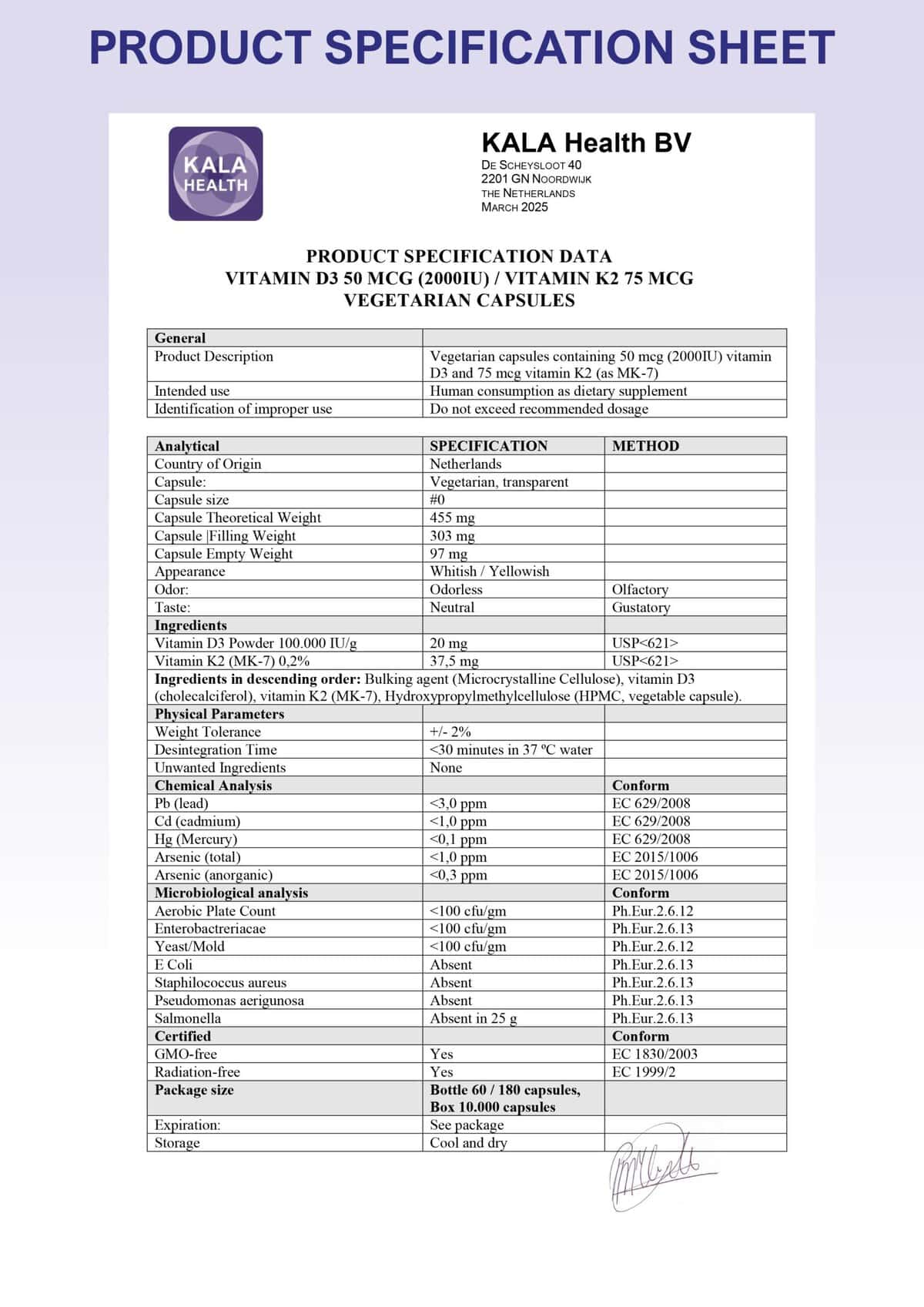
Vitamin D3 + K2 50mcg / 75mcg
- Combined Vitamin D3 2,000 IU + K2 75 mcg: optimal synergy
- Contains the most bioavailable forms of Vitamin D3 (Cholecalciferol) and K2 (MK-7) in a balanced dosage
- Vitamin D: enhances calcium absorption in the bones


Description
Vitamin D3 + K2
Two vitamins, one system. D3 contributes to the absorption of calcium. K2 contributes to the maintenance of normal bones. We encapsulate them ourselves, in the right proportions, without additives that don’t belong there.
✓ 50 mcg (2,000 IU) D3 ✓ 75 mcg K2 as MK-7 ✓ 60 or 180 capsules
What is vitamin D and why is it special?
Vitamin D is, strictly speaking, not a vitamin but a prohormone: a precursor to a hormone. Almost every cell in the human body has receptors for vitamin D, which indicates how broadly its influence reaches. Vitamin D contributes to the normal absorption of calcium and phosphorus, the maintenance of normal bones and teeth, the normal function of the immune system, the maintenance of normal muscle function, and the process of cell division.
The body produces vitamin D itself when the skin is exposed to UVB radiation from the sun. In northern Europe this is only possible from approximately April to October, and even then only between 11:00 and 15:00. For the rest of the year the sun’s angle is too low.
Why D3 and K2 together?
Vitamin D3 ensures that the intestines absorb calcium from food. Once calcium is in the bloodstream, it is then distributed throughout the body, including towards bone tissue. Vitamin K2 plays a role in that distribution: K2 activates proteins that bind calcium to bone tissue.
K2 activates two proteins through a chemical process called carboxylation. Without carboxylation these proteins remain biologically inactive, regardless of how much D3 you take.
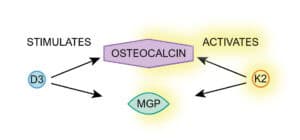
The synergy between vitamin D3 and K2 visualised: D3 stimulates the production of osteocalcin and MGP, K2 activates both proteins through carboxylation.
Osteocalcin: building calcium into bone
Osteocalcin is a protein produced by bone cells. In its inactive form it cannot bind calcium. Once vitamin K2 carboxylates it, it gains three specific binding sites for calcium ions, which are then anchored in the bone tissue. Without sufficient K2, osteocalcin circulates unused in the body.
MGP: keeping calcium out of blood vessels
Matrix Gla-Protein (MGP) is another protein activated by K2. Activated MGP binds calcium ions and is involved in calcium distribution in the body. The concentration of inactive MGP in the blood is used in scientific research as an indicator of functional K2 status.
In short: osteocalcin binds calcium to bone tissue, MGP is involved in calcium distribution elsewhere in the body. Both need K2 to switch on, and both indirectly need D3 because D3 supplies the calcium they work with.
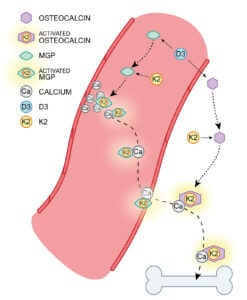
The role of vitamin D3 and K2 in calcium regulation. Vitamin D3 stimulates the production of osteocalcin and Matrix Gla-Protein (MGP). Vitamin K2 activates both proteins through carboxylation: activated osteocalcin binds calcium to bone tissue, activated MGP binds calcium in other tissues.
What this means in practice
D3 supplementation increases calcium absorption; K2 ensures that the proteins which bind this calcium to bone tissue are activated. At higher D3 doses, K2 is a logical component of the system.
The role of magnesium
Magnesium is more quietly present in this system, but indispensable. It plays a role in three places.
Activation of vitamin D3. After intake, D3 undergoes two conversion steps: first in the liver to calcifediol, then in the kidneys to calcitriol, the biologically active form. Both conversions are catalysed by enzymes that require magnesium as a cofactor. Those low in magnesium convert D3 more slowly and incompletely, even with ample D3 intake.
Bone structure and osteocalcin. Approximately 60% of the magnesium in the body is found in the skeleton, partly built into the bone mineral alongside calcium. Magnesium influences the size and stability of bone crystals: it thereby contributes to the maintenance of normal bones.
Calcium regulation at the cellular level. Magnesium regulates the calcium channels in cells: it keeps calcium outside the cell until it is needed. With a magnesium deficiency, these channels become dysregulated and calcium can accumulate in cells and tissues, exactly the problem that MGP tries to prevent on the outside of the cell. Magnesium thereby plays a role in calcium regulation at the cellular level.
D3, K2, calcium and magnesium are not four separate supplements but components of one system. A deficiency in any one of these four weakens the entire chain. That is why magnesium is often added in practice as a third component to the D3+K2 duo.
Combine with our Magnesium Complex
We therefore recommend combining D3+K2 with our Magnesium Complex. This supplement contains not only magnesium in well-absorbable forms, but also more than 75 minerals and trace elements that naturally work together in the body. Trace elements play a supporting role that you don’t get with a single magnesium supplement. It is a broad nutrient base for everything that D3 and K2 set in motion.
Why supplementation makes sense for most northern Europeans
More than 90% of vitamin D status is determined by sunlight exposure, not by diet. In northern Europe UVB radiation is strong enough for skin production from approximately April to October, and even then only between 11:00 and 15:00. For the rest of the year the body draws down its reserves.
Vitamin K2 is barely present in the western diet. The richest source is natto, a fermented Japanese soy product that almost no one in Europe eats. Aged cheese provides some K2, but in variable and generally limited amounts. For most people, the daily diet does not provide sufficient K2, especially in combination with D3 supplementation.
Which form of D3 and K2 to choose?
Vitamin D exists in multiple forms, but for supplementation two are relevant: D2 (ergocalciferol) and D3 (cholecalciferol). D3 is the form the body itself produces in the skin under the influence of sunlight, and also the form the liver most efficiently converts to calcidiol, the measurable storage form in the blood.
Research shows that a single dose of D3 is nearly twice as effective as D2 in raising those blood levels (Shieh et al., 2016; Martineau et al., 2019). The choice is therefore quickly made: always opt for cholecalciferol (D3), and check the ingredients list when in doubt, because a label that only states “vitamin D” does not provide that certainty.
For vitamin K2 a similar story applies. K2 exists in short-chain forms such as MK-4 and long-chain forms such as MK-7. The difference lies in the half-life: MK-4 is broken down within a few hours, MK-7 remains active in the body for over 72 hours. This means that MK-7 provides stable levels throughout the day with a single daily intake, while MK-4 requires multiple doses per day for the same effect. We therefore opt exclusively for MK-7.
The Kala approach: from raw material to capsule
Most supplement brands leave production entirely to third parties. We do things differently. At Kala Health we assess suppliers ourselves on certificates of analysis, purity grades and production standards before a single gram is purchased. Not every cholecalciferol and not every MK-7 is the same.
By purchasing directly from the manufacturer, without intermediaries, we pay less. The capsules are filled and packaged in our own laboratory in Oldenzaal. No external contract filler. No fillers, colourings or preservatives. Just the active ingredients, in the right dosage. We pass that saving on to you in full.
Authorised health claims
The European Health Claims Regulation permits the following statements about vitamin D, vitamin K and calcium. We include calcium here because the action of D3 and K2 only comes into effect alongside sufficient calcium from diet or supplementation.
Vitamin D
- Vitamin D contributes to normal blood calcium levels
- Vitamin D contributes to the normal absorption/utilisation of calcium and phosphorus
- Vitamin D contributes to the maintenance of normal bones
- Vitamin D has a role in the process of cell division
- Vitamin D contributes to the normal function of the immune system
- Vitamin D contributes to the maintenance of normal teeth
- Vitamin D contributes to the maintenance of normal muscle function
Vitamin K2
- Vitamin K contributes to normal blood clotting
- Vitamin K contributes to the maintenance of normal bones
Calcium
- Calcium is needed for the maintenance of normal bones
- Calcium contributes to normal blood clotting
- Calcium has a role in the process of cell division and specialisation
- Calcium contributes to a normal energy-yielding metabolism
- Calcium is needed for the maintenance of normal teeth
- Calcium contributes to normal muscle function
- Calcium contributes to the normal function of digestive enzymes
- Calcium contributes to normal neurotransmission
Product features
- Vitamin D3 as cholecalciferol (50 mcg / 2,000 IU per capsule)
- Vitamin K2 as MK-7 (75 mcg per capsule), the long-chain form with approximately 72 hour half-life
- Plant-based HPMC capsules, suitable for vegetarians and vegans
- Fully produced in our own FSSC 22000-certified facility in the Netherlands
- Available in 60 or 180 capsules per pack
- Free from preservatives, synthetic flavourings, colourings and fragrances
- GMO-free and not irradiated in accordance with EU legislation
- Product Specification Sheet viewable in the product gallery
Important safety information
Vitamin K2 reduces the effectiveness of coumarin-based blood thinners such as warfarin, acenocoumarol and phenprocoumon. Do NOT use this supplement when taking these medicines without consulting your doctor or pharmacist. Not suitable for children up to and including 10 years of age.
A food supplement is not a substitute for a varied diet. A varied, balanced diet and a healthy lifestyle are important. Consult an expert before taking supplements in cases of pregnancy, lactation, medication use or illness. Health claims in accordance with EFSA Regulation (EU) 432/2012.
Written by Marijn Lewis, PhD
Science Communication & Nutrition Research at Kala Health
About Kala Health
Kala Health was founded in 1997 by Paul Klein Breteler. Since then he has been formulating his own supplements, treating clients and advising on nutrition and supplementation. This combination of developing, producing and advising has always been at the heart of Kala Health. We make no compromises on quality and carefully test all raw materials in independent laboratories.
We now work with a team of nutrition specialists, an in-house therapist and a pharmacist. Everything takes place in our own FSSC 22000-certified facility in the Netherlands: from raw material analysis to finished product, under our own supervision. This integrated approach allows us to deliver products you can fully trust: transparent, pure and effective.
References
- Martineau, A. R., Thummel, K. E., Wang, Z., Jolliffe, D. A., Boucher, B. J., Griffin, S. J., Forouhi, N. G., & Hitman, G. A. (2019). Differential Effects of Oral Boluses of Vitamin D2 vs Vitamin D3 on Vitamin D Metabolism: A Randomized Controlled Trial. The Journal of Clinical Endocrinology and Metabolism, 104(12), 5831-5839. https://doi.org/10.1210/jc.2019-00207
- Shieh, A., Chun, R. F., Ma, C., Witzel, S., Meyer, B., Rafison, B., Swinkels, L., Huijs, T., Pepkowitz, S., Holmquist, B., Hewison, M., & Adams, J. S. (2016). Effects of High-Dose Vitamin D2 Versus D3 on Total and Free 25-Hydroxyvitamin D and Markers of Calcium Balance. The Journal of Clinical Endocrinology and Metabolism, 101(8), 3070-3078. https://doi.org/10.1210/jc.2016-1871
Composition
Vitamin D3 + K2 50mcg/75mcg contains the following ingredient:
Ingredients
| Composition per capsule (daily dosage): | %RI* | |
|---|---|---|
| Vitamin D3 (Cholecalciferol 2000 IU) | 50 mcg | 1000% |
| Vitamin K2 | 75 mcg | 105% |
*RI = Reference Intake
Ingredients: Microcrystalline cellulose (Type P102), Vitamin K2 (MK-7) (0.2%), Cholecalciferol (100,000 I.U./g), vegetarian HPMC (Capsule)
Guaranteed free from: Preservatives, synthetic fragrances, colors, and flavors.
Use & dosage
Recommended use
| For Who? | Daily Dosage |
|---|---|
| Adults: | 1 capsule per day |
Daily dosage: Adults 1 capsule per day, or as recommended. Preferably take during a meal. Adhere to the (recommended) daily dosage.
Mandatory statement: A dietary supplement is not a substitute for a varied diet. A varied, balanced diet and a healthy lifestyle are important. This product is a dietary supplement (contains vitamins).
Safety
- Consult an expert before using supplements in case of pregnancy, lactation, medication use, and illness.
- This dietary supplement is not suitable for children up to and including ten years of age.
Storage advice
Storage: In a dry place at room temperature, and out of reach of small children.
Background information
Recognising a deficiency
Possible signs of vitamin D deficiency
A deficiency develops slowly. In northern Europe an estimated 35 to 60% of the population has an insufficient vitamin D status, particularly during the winter months.
- Persistent fatigue without a clear cause
- Muscle pain, weakness or cramps
- Bone pain, particularly in the lower back, legs or ribs
- More frequent illness, delayed wound healing
- Low mood or concentration problems, particularly in winter
Possible signs of vitamin K2 deficiency
K2 deficiency is quieter and less specific. Severe clinical deficiencies are rare, but suboptimal status is common, especially in people who eat little fermented food.
- Bruising that occurs easily without cause
- Nosebleeds or bleeding gums
- Wounds that bleed for a long time
- Bone complaints or sensitive gums in the long term
Have a blood test if in doubt
Vitamin D status is easily measured via a 25(OH)D blood test at your GP. There is no broad standard test for K2; status is generally estimated based on dietary patterns and risk factors.
Frequently asked questions