
 Made in the Netherlands
 Free product of your choice with orders over €75,-




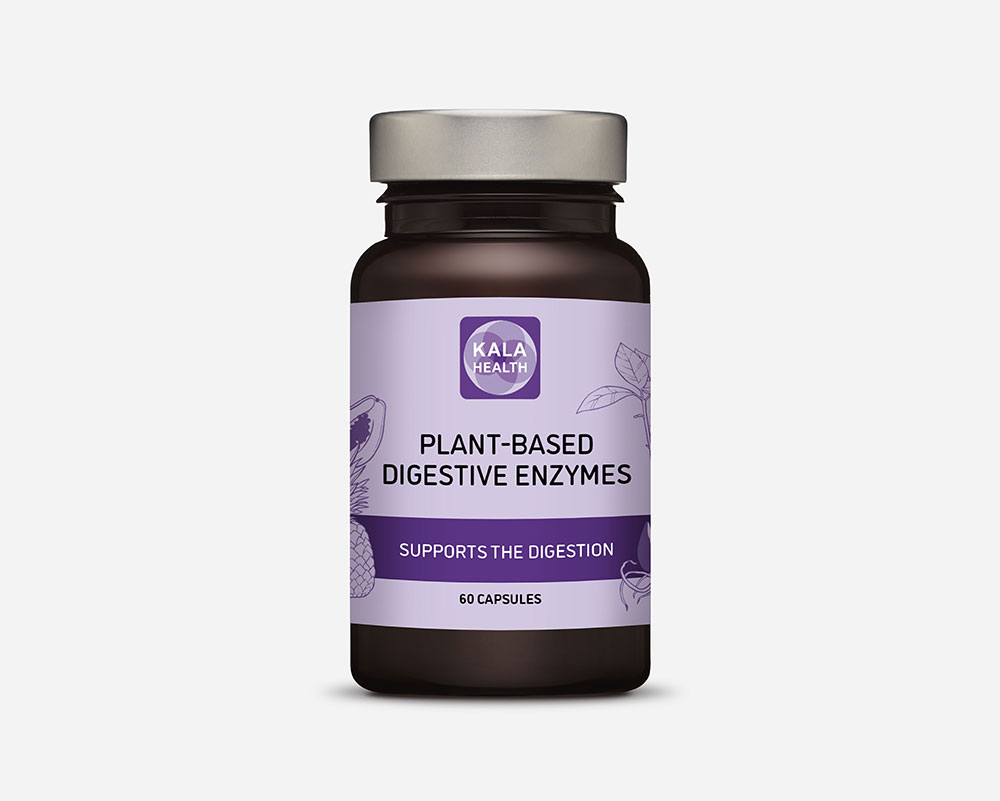


Natural Enzymes
- 8 different enzymes in 1 formula: Protease (6 types), amylase and lipase – 100% plant-based via fermentation.
- Active in broad pH range (3.0-9.0): Effective from stomach to intestines, no acid-resistant coating needed.
- Produced in our own factory: Complete chain control from raw material procurement to encapsulation in the Netherlands.


Description

Natural Enzymes
Plant-based enzyme formula with protease, amylase and lipase. Produced via fermentation with Aspergillus oryzae and Bacillus subtilis, supplemented with papain from papaya and bromelain from pineapple. Active in broad pH range (3.0-9.0).
✓ 8 different enzymes ✓ 100% plant-based ✓ Fully produced in our own factory in the Netherlands
Plant-Based Enzyme Formula by Kala Health
Kala Health Natural Enzymes™ is a carefully formulated blend containing exclusively plant-based enzymes. The enzymes are produced via natural fermentation using fungi such as Aspergillus oryzae and Bacillus subtilis. Additionally, the supplement contains papain (from papaya) and bromelain (from pineapple).
This formula contains a combination of eight different enzymes, each with specific properties. The selection is based on their unique characteristics and their activity in different pH environments.
Developed by Paul Klein Breteler
Paul Klein Breteler, founder of Kala Health since 1997, developed this enzyme formula with a focus on plant-based ingredients and broad pH range. Since its founding, Kala Health has been producing high-quality supplements in-house. This enzyme formula is fully developed and manufactured in our FSSC-22000 certified factory in the Netherlands – from raw material procurement to encapsulation. Enzyme activity is determined according to the Food Chemical Codex procedure, recognized by the FDA.
What Are Enzymes?
Enzymes are proteins that play a role in biochemical reactions in biological systems. In nature, enzymes are found in all living organisms, from plants to microorganisms. Enzymes are typically classified based on the type of substrate on which they act.
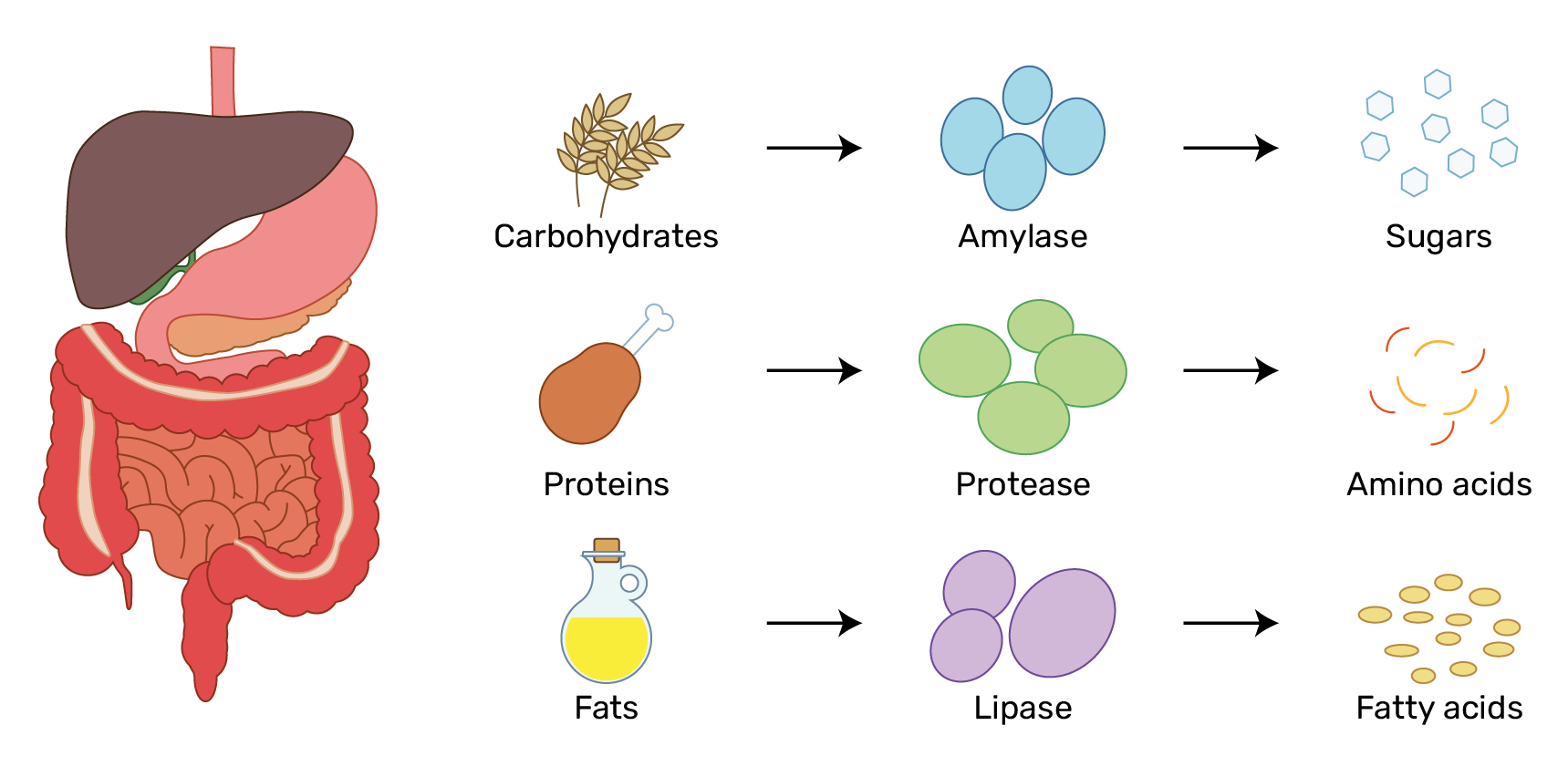
Three Main Groups of Enzymes
Enzymes can be divided into different classes, depending on their specificity:
- Proteases – Enzymes that act on proteins. Kala Health Natural Enzymes contains three different proteases (Protease 3.0, 4.5 and 6.0), plus pepsin, papain and bromelain
- Amylases – Enzymes that act on carbohydrates. This formula contains 1,330 DU amylase per capsule
- Lipases – Enzymes that act on fats. This formula contains 50 FCCLU lipase per capsule
The Action of Enzymes
History of Plant-Based Enzymes
Enzymes have been used naturally by humans for centuries, long before their scientific function was understood. In traditional Asian cultures, fermentation processes using fungi such as Aspergillus oryzae have been applied for over 2000 years in the production of foods such as sake, miso, and soy sauce.
The scientific discovery of enzymes began in the 19th century. In 1833, French chemist Anselme Payen isolated the first enzyme (diastase, an amylase) from barley. The term “enzyme” was introduced in 1877 by German physiologist Wilhelm Kühne, derived from the Greek word “en zymē” (in yeast).
For a long time, enzymes were primarily obtained from animal sources, such as pepsin from pig stomachs and trypsin from cattle pancreas. The development of fermentation technology in the 20th century made it possible to produce enzymes on an industrial scale via microorganisms, leading to cleaner, more consistent, and ethically responsible production processes.
Today, plant-based enzymes are produced according to standardized fermentation protocols, where specific fungal strains produce enzymes under controlled conditions. This results in high-quality, pure enzyme preparations that are suitable for vegetarians and vegans.
Plant-Based Origin via Fermentation
The enzymes in this formula are of microbial origin and are produced via controlled fermentation. This production process uses specific fungal strains:
- Aspergillus oryzae – A fungus traditionally used in Asian fermentation processes, such as in the production of miso and sake
- Bacillus subtilis – A bacterium that produces enzymes via fermentation and is used worldwide in the food industry
- Papaya (Carica papaya) – Source of papain, a naturally occurring enzyme in the fruit
- Pineapple (Ananas comosus) – Source of bromelain, a naturally occurring enzyme in the plant
By using fermentation instead of animal sources, this product is suitable for vegetarians and vegans. The capsules are also plant-based (hydroxypropylmethylcellulose).
Plant-Based vs. Animal-Derived Enzymes
Traditionally, enzyme supplements were often obtained from animal sources. Pepsin, for example, was extracted from pig stomachs, while trypsin came from cattle pancreas. Although these animal-derived enzymes are active, they come with several disadvantages:
- Not suitable for vegetarians and vegans – Animal-derived enzymes are by definition of animal origin
- Ethical concerns – Animal organs are required for production
- Religious restrictions – Not halal or kosher certified if derived from pork
- Limited pH range – Animal enzymes are often optimized for specific pH values and less stable outside their optimum
- Batch variability – Enzymes from animal sources may show more variation between batches
Plant-based enzymes via fermentation offer several advantages:
- 100% plant-based – Suitable for vegetarians, vegans, and all religious dietary requirements
- Broad pH range – Microbial enzymes are active from pH 3.0 to 9.0, meaning they can be active in different environments
- Stable and consistent – Produced under controlled fermentation conditions, resulting in consistent quality
- No coating needed – Thanks to stability in acidic environments, an acid-resistant coating is unnecessary
- Sustainable and scalable – Fermentation is an efficient production process without dependence on animal raw materials
Kala Health has deliberately chosen plant-based enzymes via fermentation because this offers the best combination of quality, effectiveness, and ethical production.
Active in Broad pH Range
An important characteristic of the enzymes in this formula is their activity over a broad pH range from 3.0 to 9.0. This means they can be active in both acidic and alkaline environments.
For comparison: the stomach has a pH of approximately 1.5-3.5 (very acidic), while the small intestine has a pH of approximately 7.0-8.5 (slightly alkaline). Microbial enzymes of plant-based origin are less sensitive to temperature and acidity than some other enzymes, meaning a special acid-resistant coating is not necessary.
Food Chemical Codex Standard
The enzyme activity of Kala Health Natural Enzymes is determined according to the Food Chemical Codex (FCC) procedure. This is an internationally recognized standard for the quality of food ingredients, recognized by the FDA (Food and Drug Administration).
Food Chemical Codex – Quality Standard Explained
The Food Chemical Codex (FCC) is a collection of internationally recognized standards for the identity, purity, and quality of food ingredients. Published by the United States Pharmacopeia (USP) and recognized by the FDA, the FCC is considered worldwide as the gold standard for food ingredients.
Why is FCC important for enzymes?
For enzymes, the FCC is particularly relevant because this standard prescribes specific test methods to measure enzyme activity. Unlike regular ingredients that are simply weighed, for enzymes the biological activity must be measured – how much substrate can the enzyme convert under standardized conditions?
The FCC defines specific activity units for each type of enzyme:
- SAPU (Spectrophotometric Acid Protease Unit) – Measures the activity of acid proteases
- HUT (Hemoglobin Unit Tyrosine) – Measures the activity of proteases at different pH values
- PU (Papain Unit) – Measures the activity of papain
- DU (Dextrinizing Unit) – Measures the activity of amylase
- FCCLU (Food Chemical Codex Lipase Unit) – Measures the activity of lipase
By measuring enzyme activity according to FCC standards, manufacturers can guarantee that each batch has consistently the same potency. This prevents situations where a product contains the same amount of enzyme on paper, but is actually less active.
Kala Health commitment: All enzyme activities in our Natural Enzymes are measured according to FCC procedures by independent, accredited laboratories. This guarantees that you receive a product with the specified and active enzyme activity.
Complete Chain Control: From Raw Material to Capsule
Kala Health Natural Enzymes is fully manufactured in our own FSSC-22000 certified factory in the Netherlands. We are not a reseller that purchases a product and applies a label. On the contrary: from selecting and purchasing raw materials to encapsulation and filling – every step takes place in-house, under direct supervision of our experienced quality team.
What Complete Chain Control Means
- Source raw materials ourselves – Direct selection and evaluation of suppliers worldwide
- Blend and formulate ourselves – Own recipe developed by Paul Klein Breteler
- Encapsulate ourselves – Own encapsulation machines in cleanroom environment
- Fill and package ourselves – From bulk to final packaging in our own facility
- Test ourselves – In collaboration with independent, ISO-certified laboratories
- Complete traceability – From raw material certificate to finished product per batch
The result: A product you can fully trust, without hidden links in the chain. And thanks to this integrated approach, we can deliver premium quality at a fair price – no profit margins for intermediaries or external co-packers.
Quality Control per Batch
Kala Health Natural Enzymes is manufactured according to strict quality standards. Each production batch is subjected to extensive testing:
- Microbiological control – Aerobic Plate Count <1000 cfu/g, yeast/mold <100 cfu/g, tested negative for E. coli and Salmonella (in accordance with EC 2073/2005)
- Heavy metals analysis – Lead <3.0 ppm, cadmium <1.0 ppm, mercury <0.1 ppm (in accordance with EC 629/2008)
- Enzyme activity – Measured according to Food Chemical Codex (FCC) procedure
- Identity and purity – Verified via standardized test methods
The product is supplied in plant-based capsules (HPMC, size 1) with a theoretical content of 260 mg per capsule. The capsules are transparent and contain an off-white powder with a characteristic odor and taste.
For Whom is This Product Suitable?
Kala Health Natural Enzymes is a dietary supplement for adults. The product is suitable for:
- Vegetarians and vegans – All enzymes are of plant-based or microbial origin, the capsules are plant-based (HPMC)
- Adults from 18 years – Recommended daily dosage is 1-2 capsules per day
- People who want to take supplements with meals – The recommended intake is during a meal
Not suitable for: Children under 18 years. Consult an expert before using supplements in case of pregnancy, lactation, medication use, and illness.
Why Own Production Makes the Difference
Many supplement companies outsource their production to so-called “co-packers” – external factories that produce for multiple brands. Not us. Kala Health has deliberately invested in its own FSSC-22000 certified factory in the Netherlands. This means: direct quality control at every step, rapid intervention in case of deviations, and complete transparency from raw material to finished product. No intermediaries, no hidden links. Only pure quality, produced as it should be.
Product Features
- Fully produced in own factory – From raw material procurement to encapsulation in the Netherlands, complete chain control
- 100% plant-based – All enzymes of plant-based or microbial origin, plant-based capsules (HPMC)
- 8 different enzymes – Protease (6 types), amylase and lipase in one formula
- Broad pH range – Active from pH 3.0 to 9.0
- Fermentation – Produced with Aspergillus oryzae and Bacillus subtilis
- Fruit enzymes – Contains papain from papaya and bromelain from pineapple
- Food Chemical Codex – Enzyme activity measured according to FDA-recognized standard
- FSSC-22000 certified – Produced in own certified factory in the Netherlands
- Extensively tested – Microbiological control and heavy metals analysis per batch
- No unnecessary additions – Free from preservatives and synthetic additives
- No coating needed – Stable without acid-resistant coating
With Emphasis Stated
Due to legal restrictions, we cannot mention all details about this dietary supplement. For substantive questions or personal advice, we are available by phone at: (+31) 070-345-0290. And by email: info@kalahealth.eu.
Mandatory statement: A dietary supplement is not a replacement for a varied diet. A varied, balanced diet and a healthy lifestyle are important. This product is a dietary supplement.
Questions about this product? Contact us for personal advice from our team of nutrition specialists.
Composition
Natural Enzymes consist of the following ingredients:
Ingredients
Composition & Ingredients
| Enzyme | Per capsule | %RI* |
|---|---|---|
| Protease 3.0 | 40 SAPU | – |
| Protease 4.5 | 40,000 HUT | – |
| Protease 6.0 | 6,667 HUT | – |
| Pepsin (1:10,000) | 5 mg | – |
| Papain | 266,660 PU | – |
| Bromelain | 266,660 PU | – |
| Amylase | 1,330 DU | – |
| Lipase | 50 FCCLU | – |
*%RI = EU Reference Intake
Activity units:
- SAPU = Spectrophotometric Acid Protease Unit (measures activity of acid proteases)
- HUT = Hemoglobin Unit Tyrosine (measures activity of proteases at different pH values)
- PU = Papain Unit (measures activity of papain and bromelain)
- DU = Dextrinizing Unit (measures activity of amylase)
- FCCLU = Food Chemical Codex Lipase Unit (measures activity of lipase)
Ingredients:
Enzymes (100 mg), microcrystalline cellulose (filler), hydroxypropylmethylcellulose (plant-based capsule).
NOT added: yeast, sugar, starch, gluten, lactose, preservatives, artificial flavors, colors, and flavorings.
Use & dosage
Recommended use
Recommended Use
| For whom | Daily dosage |
|---|---|
| Adults | 1 to 2 capsules per day |
Daily dosage: Adults 1 to 2 capsules per day, or as recommended. Preferably take during a meal with some water. Adhere to the (recommended) daily dosage.
Storage advice: Store in a dry place at room temperature, out of reach of small children. Refrigeration is not required.
Mandatory statement: A dietary supplement is not a replacement for a varied, balanced diet and a healthy lifestyle.
Safety: Consult an expert before using this supplement in case of pregnancy, breastfeeding, medication use, or illness. Not suitable for children under 18 years.
Packaging: Available in bottles of 60 or 180 capsules.
Storage advice
Storage: In a dry place at room temperature, and out of reach of small children.
Frequently Asked Questions