
 Made in the Netherlands
 Free product of your choice with orders over €75,-




MSM GC, MSM GC Plus and MSM GC Vegan. Three product names that mean very…
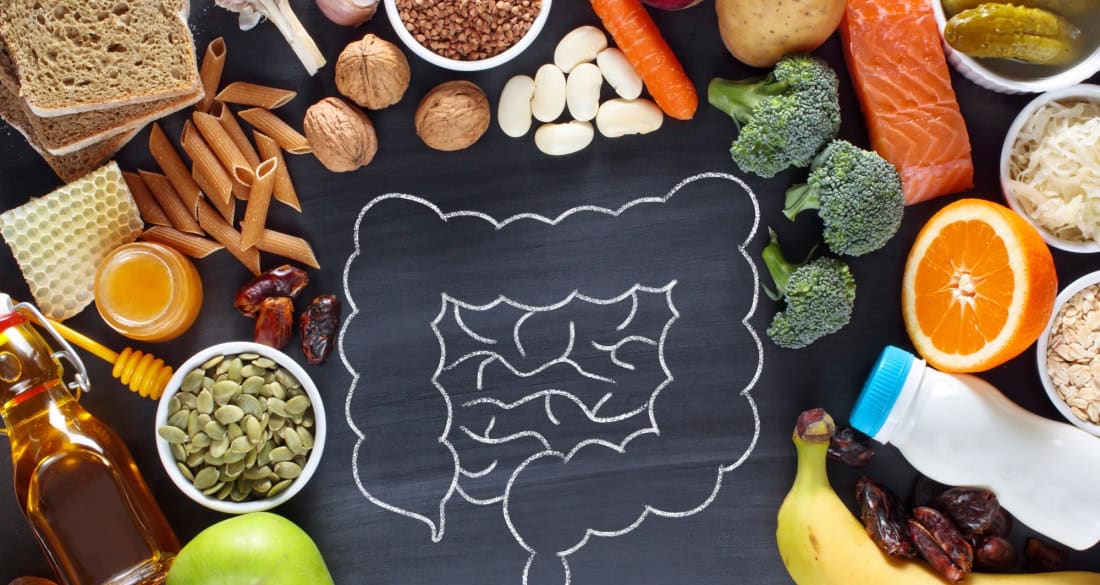
Your Bathroom Visits Say Something About Your Fibre Intake
Fibre: the underrated part of a healthy diet.
While protein tops most people’s priority list, especially among athletes and influencers, fibre intake often gets overlooked. You notice the gap quickly enough: a protein-rich diet without enough fibre often goes hand in hand with more difficult trips to the bathroom.
In this article you’ll learn why fibre matters, how to best introduce it into your diet, and what to watch for to reduce its well-known side effects (gas and bloating).
Please note: by law, we are not permitted to make health claims about dietary fibre in general. What follows are the known biological mechanisms of fibre in the gut, as described in the scientific literature, along with the specific EFSA-approved claims that do exist for certain individual fibre types. Always consult a doctor if you experience health complaints.
Why fibre matters
The Dutch Nutrition Centre (Voedingscentrum) recommends a minimum of 25 grams of fibre per day for women and 30 grams for men. That might not sound like much, but most Dutch adults fall short of it. The most recent Dutch National Food Consumption Survey by the RIVM (2019–2021) found that Dutch adults consume an average of just 21 grams of fibre per day, well below the recommendation.
Dietary fibre consists of the indigestible parts of plant-based food: carbohydrates that are not broken down in the small intestine but largely reach the colon intact. That is where the real work happens. Part of the fibre is fermented by the bacteria living in the colon, while another part adds bulk and binds water in the stool.
Adequate fibre intake is associated with regular bowel movements, a feeling of fullness, and the effects that arise when gut bacteria ferment fibre into short-chain fatty acids such as butyrate, propionate, and acetate. These short-chain fatty acids are an important energy source for the cells lining the wall of your colon.
A well-studied topic in microbiome research is the difference in gut flora composition between a diet low in fibre and high in processed food (the Western diet) and a diet high in fibre and low in sugar. Observational research links low fibre intake with a less diverse bacterial composition, while a fibre-rich diet is associated with a greater presence of beneficial bacterial strains.
Why does fibre cause gas?
When gut bacteria ferment dietary fibre, they also produce gases, mainly hydrogen. This can cause a feeling of bloating, especially if you’re not used to eating much fibre. This is a normal part of the fermentation process, not a sign that something is wrong. Research shows that these symptoms tend to subside within a few days to a few weeks for most people, depending on the type and amount of fibre.
Not every fibre is broken down by the body in the same way. Fibres differ greatly in solubility, viscosity, and fermentation rate, and these differences directly determine how a fibre feels in practice: from entirely unnoticeable to clearly noticeable in the form of bloating or gas.
Fibres with a high fermentation rate
Inulin is one of the most widely used fibres in supplements and functional foods, often sourced from chicory. Inulin is a fructan: a chain of fructose units with a relatively short chain length. Fructans fall under the FODMAP classification (Fermentable Oligo-, Di-, and Monosaccharides And Polyols), the category of short-chain carbohydrates known for rapid and extensive fermentation by gut bacteria.
This rapid fermentation is more likely to result in a bloated feeling. However, there are also fibres with a longer, more diversely structured chain and a different fermentation profile, which are classified as low-FODMAP.
It’s not just the amount of fibre, but also the type of fibre, that determines how your body responds.
A slower alternative: PHGG
Partially hydrolyzed guar gum (PHGG) is a fibre that is fermented much more slowly by gut bacteria. PHGG is a hydrolyzed version of guar gum fibre.
Guar gum fibre naturally consists of long polysaccharide chains (galactomannans) that form a thick, often slimy gel in water. Galactomannans, for example, are used to promote satiety because they attract a lot of water. As a result, unprocessed guar gum can give an unpleasant mouthfeel and has limited solubility.
PHGG is broken down into shorter fragments, resulting in a lower molecular weight and lower viscosity, and dissolves completely in water without gelling.
This structural change is not only relevant for taste and ease of use. The molecular weight and chain length of a fibre also determine how quickly and how intensively gut bacteria can ferment that fibre. Unlike inulin, PHGG has been certified low-FODMAP by Monash University.
What this means for fermentation rate
An in vitro fermentation study in which PHGG, inulin, and wheat dextrin were exposed to gut bacteria under identical conditions showed a clear difference in fermentation speed. Inulin reached its lowest pH value (a measure of fermentation intensity) after just 8 hours, while PHGG reached its lowest pH value after 12 hours, and wheat dextrin after 24 hours (Noack et al., 2013). This aligns with what is more broadly known about fructans: shorter chains such as inulin are fermented faster and more intensely, while more slowly fermentable fibres spread that fermentation over a longer stretch of the colon.
What we do know about higher doses
For inulin and its shorter-chain variant FOS (fructo-oligosaccharides), research generally shows that higher doses cause more gas and bloating, with a noticeable increase above roughly 10 to 15 grams per day. The picture here is not entirely consistent: some dose-response studies find mild complaints already at low doses (2.5 to 5 grams) that do not increase further at higher doses. A strictly linear relationship between dose and complaints is therefore not what the literature consistently shows, though the general tendency towards more complaints at higher intake levels is present.
Considerable clinical research has been conducted on PHGG specifically. A randomized, double-blind crossover trial showed that PHGG did not interfere with the absorption of glucose, amino acids, or fat, and had no adverse effects on haematological, hepatic, pancreatic, or renal function, in subjects consuming liquid diets containing 21 grams of PHGG per litre (Alam et al., 1998). Separate research into bowel movement frequency showed that 36 grams of PHGG per day, over 4 weeks, increased faecal mass and defecation frequency without reported side effects (Takahashi et al., 1993; Polymeros et al., 2014).
Randomized research in people with irritable bowel syndrome (IBS) shows good tolerability of PHGG at doses of 6 grams per day, with no significant side effects compared to placebo (Niv et al., 2016).
Approved health claims
The European Food Safety Authority (EFSA) determines which approved health claims may be used for which foods. Oddly enough, no EU claim exists for fibre in general, despite the claim “dietary fibre is important” being well substantiated.
There is really only one fibre with an EFSA-approved claim relating to bowel movements and digestive comfort, and that is chicory inulin. The claim “chicory inulin contributes to normal bowel function by increasing stool frequency” has been approved by the European Commission, provided at least 12 grams per day are consumed.
Other approved claims exist for specific dietary fibres, such as oat and barley fibre (“contributes to an increase in faecal bulk”) and rye fibre (“contributes to normal bowel function”). These claims do not carry a fixed daily dose as with inulin, but a concentration requirement: the product must contain enough fibre to be labelled ‘source of fibre’ or ‘high in fibre’, according to the EU nutrition claim rules. There is also an approved claim for beta-glucans from oats or barley and the post-meal blood sugar response, with its own specific dosage per serving.
There is no EU claim of the type “fibre contributes to healthy digestion” that we are permitted to use.
Plant-Based Dietary Fibre — Kala Health
100% PHGG, a soluble dietary fibre that serves as a substrate for the bacteria in your colon. Suitable for those with a more sensitive digestion who still want to increase their fibre intake. Fully manufactured in the Netherlands.
Written by Marijn Lewis, PhD
Science Communication & Nutrition Research at Kala Health
Frequently asked questions
How much fibre do I need per day?
The Dutch Nutrition Centre recommends a minimum of 25 grams of fibre per day for women and 30 grams for men. Most Dutch adults fall short of this: average intake, according to the RIVM, is around 21 grams per day.
Why does fibre give me gas?
When gut bacteria ferment fibre, gases are produced, mainly hydrogen. This is a normal part of the fermentation process. With gradual build-up, these symptoms tend to subside within a few days to weeks for most people.
Is PHGG a good alternative if I’m sensitive to inulin?
PHGG ferments more slowly than inulin and, unlike inulin, is certified low-FODMAP by Monash University. However, a direct comparative study between the two at the level of digestive symptoms in humans is lacking, so this is a mechanistically grounded assumption rather than a proven outcome.
Are you allowed to say that fibre is good for digestion?
Not as a general claim. Within the EU, we as a manufacturer are not permitted to make health claims that have not been approved by EFSA. Approved claims exist only for specific fibre types, such as chicory inulin, oat, barley, and rye fibre, each with their own conditions. No comparable approved claim exists for PHGG.
Sources
- Alam, N. H., Meier, R., Rausch, T., Meyer-Wyss, B., Hildebrand, P., Schneider, H., Bachmann, C., Minder, E., Fowler, B., & Gyr, K. (1998). Effects of a partially hydrolyzed guar gum on intestinal absorption of carbohydrate, protein and fat: a double-blind controlled study in volunteers. Clinical Nutrition, 17(3), 125–129.
- Niv, E., et al. (2016). Randomized clinical study: Partially hydrolyzed guar gum (PHGG) versus placebo in the treatment of patients with irritable bowel syndrome. Nutrition & Metabolism, 13, 10.
- Noack, J., Timm, D., Hospattankar, A., & Slavin, J. (2013). Fermentation profiles of wheat dextrin, inulin and partially hydrolyzed guar gum using an in vitro digestion pretreatment and in vitro batch fermentation system model. Nutrients, 5(5), 1500–1510.
- Polymeros, D., et al. (2014). Partially hydrolyzed guar gum accelerates colonic transit time and improves symptoms in adults with chronic constipation.
- RIVM, Dutch National Food Consumption Survey 2019–2021 (wateetnederland.nl/resultaten/energie-en-macronutrienten/vezel).
- Takahashi, H., et al. (1993). Effect of partially hydrolyzed guar gum on fecal output in healthy men.
Questions about fibre?
Want to know more, or have a question about your own situation? Our team of nutrition specialists and therapists is happy to think along with you. Call us at (+31) 070 345 0290 or email info@kalahealth.eu.
A food supplement is not a substitute for a varied, balanced diet and a healthy lifestyle. Consult a healthcare professional in case of pregnancy, breastfeeding, medication use, or illness. Due to legal restrictions, we are not permitted to publish all information about the effects of this food supplement.
Related Posts