 Made in the Netherlands
 Free product of your choice with orders over €75,-




MSM GC, MSM GC Plus and MSM GC Vegan. Three product names that mean very…

Akkermansia Muciniphila — What the Science Says (2026)
In January and May 2026, two papers appeared in the journal Nature that cast the conversation about Akkermansia muciniphila in a new light. Not because the bacterium has suddenly changed, but because the science has become sharper about what we know and what we do not yet know.
In this article you will read what these papers say, what role the protein Amuc_1100 plays, why pasteurised Akkermansia muciniphila is the only permitted supplement form in the EU, and what the quality differences between products really mean.
What Nature Microbiology says: the nuance behind the enthusiasm
In January 2026, the Luxembourg Institute of Health published a perspective article in Nature Microbiology titled “Navigating the duality of Akkermansia muciniphila.” The article is relevant for anyone considering Akkermansia, because it describes what scientists currently understand and where the limits of that knowledge lie.
The core point: the effects of Akkermansia muciniphila in scientific research appear to vary by person, by diet, by existing microbiome and by bacterial strain. Different strains show different properties in studies. This context-dependence is no reason for scepticism, but it is a reason to distinguish between supplements. The researchers explicitly argue for a careful, evidence-based approach (Desai et al., 2026).
Not all Akkermansia muciniphila is equal. Strain, form and quality determine what is in a capsule.
This makes the question of raw material quality more relevant than ever. If strain differences and product quality determine what is in a capsule, transparency about the raw material is not a marketing story but a substantive argument.
The key role of Amuc_1100
One of the most relevant insights from recent research concerns the protein Amuc_1100. This protein is located in the outer membrane of Akkermansia muciniphila and is one of the most extensively studied components of the bacterium.
Crucially: pasteurisation leaves Amuc_1100 untouched. The protein remains structurally preserved after the pasteurisation process. The pasteurised form and the membrane protein Amuc_1100 have been studied extensively in scientific research (Plovier et al., 2017). In the EU, only the pasteurised form has been assessed and authorised by EFSA as a safe novel food.
Amuc_1100 sits in the outer membrane of Akkermansia muciniphila and remains structurally preserved after pasteurisation.
An additional practical advantage: pasteurised Akkermansia muciniphila is stable at room temperature, requires no refrigeration and, unlike live bacteria, does not have to ‘survive’ anything in the stomach. It is already inactive; only the protein structure matters.
Probiotic, prebiotic or postbiotic?
These three terms are regularly confused in practice, including for Akkermansia muciniphila. That is understandable, because the categories are not always intuitive for consumers, and supplement brands sometimes use them loosely. Scientifically, however, the definitions are precise, and the distinction is relevant for Akkermansia muciniphila.
A probiotic is by definition a live micro-organism that, when administered in adequate amounts, confers a health benefit on the host (FAO/WHO, 2001). The word live is the key concept. A prebiotic is a substrate that is selectively fermented by host micro-organisms and thereby confers a health benefit. A definition that is broader than fibre alone and also includes certain polyphenols (ISAPP, 2017). A postbiotic, finally, is, according to the formal consensus definition of the International Scientific Association for Probiotics and Prebiotics (ISAPP, 2021): “a preparation of inanimate micro-organisms and/or their components that confers a health benefit on the host.”
Pasteurised Akkermansia muciniphila is not a probiotic (it contains no live bacteria) and not a prebiotic (it is itself the active constituent, not a substrate for other bacteria). Whether it is formally a postbiotic depends on which definition you apply. According to the ISAPP definition from 2021, the most authoritative scientific description at present, pasteurised Akkermansia muciniphila meets the criteria. Leading researchers in this field, including Prof. Patrice Cani, share this view.
Legally, pasteurised Akkermansia muciniphila falls into the novel food category in the EU, a separate EU legal category for food ingredients without a long history of use in Europe.
Why pasteurised, and why that is good news
Pasteurisation kills the bacterium but leaves the outer membrane intact, including the protein Amuc_1100. Pasteurised Akkermansia muciniphila is stable at room temperature and requires no refrigeration. You can read more about how this works on our product page.
What the most recent clinical trial examined
In May 2026, Maastricht University Medical Center published a randomised controlled trial in Nature Medicine. The trial examined the effect of daily intake of pasteurised Akkermansia muciniphila in 90 adults with overweight, over a period of 24 weeks (6 months). The trial was double-blind and placebo-controlled, and registered with ClinicalTrials.gov under number NCT05417360 (Mount et al., 2026).
Two studies, the same dosage
Both the Microbes4U trial (Depommier et al., 2019) and the recent Mount study (2026) used a dosage of 3×10¹⁰ cells per day. That is 30 billion cells, the same dosage that is also in our capsules. The full publications are freely accessible via the sources at the end of this article.
For legal reasons, we may not make any statements about the outcomes of these studies in relation to our product.
Why not all Akkermansia supplements are equal
What the Nature Microbiology researchers describe about strain differences and quality is not abstract: it has a direct practical meaning.
An Akkermansia capsule is only as good as the raw material it is made from.
That sounds obvious, but in practice the quality of Akkermansia raw materials varies greatly, and most brands do not make this transparent.
To know what is really in a raw material, you can analyse the DNA. That is exactly what we do with our metagenomic analysis: it maps the entire genetic material in the powder and shows which organisms are present and in what proportion. For our raw material, the result is: 99.84% of the genetic material comes from Akkermansia muciniphila. The remaining 0.16% consists of by-products of the fermentation process, no foreign bacteria or contaminants.
Are the bacteria really dead?
Pasteurised Akkermansia muciniphila may not contain live bacteria in the EU. EFSA requires that fewer than 10 live cells per gram (10 CFU) are detectable. That sounds simple, but it is not. With most pasteurisation methods, some of the bacteria simply survive the process. Many producers therefore do not meet this requirement.
The real problem: you cannot simply heat harder
This is where the core of the quality difference lies. To kill all bacteria, you can in principle heat harder or longer. But then the outer membrane of the bacterium is also lost, and with it the structure of Amuc_1100 that needs to be preserved. Fully inactivating and at the same time keeping Amuc_1100 intact is technically difficult, and most raw material producers do not succeed.
The raw material we use is unique on this point: at four measurement moments during the production process, after inoculation, after fermentation, after centrifugation and after drying, no live cells were found. Externally verified.
99.84%
Purity of our raw material, demonstrated by metagenomic analysis at species level
Purity of our raw material, demonstrated by metagenomic analysis at species level
0 CFU
At every measurement point through the fermentation process, externally verified
At every measurement point through the fermentation process, externally verified
4×
Measurement moments through the fermentation process, not only on the final product
Measurement moments through the fermentation process, not only on the final product
After approval of the raw material, we encapsulate all batches ourselves, in our own factory in the Netherlands. Purchasing, testing, encapsulation and packaging: all under one roof. This gives us full control over every production step and enables us to provide complete label transparency. The product specification sheet of our Akkermansia Capsules is available for inspection in the product gallery on our product page.
Akkermansia Capsules — Kala Health
30 billion pasteurised Akkermansia muciniphila cells per capsule. Own production in the Netherlands, 50% better value than comparable products. Product specification sheet available on the product page.
Akkermansia and probiotics: what you need to know
Many people considering Akkermansia muciniphila already use a probiotic and wonder whether that combination is useful or problematic.
Classic probiotics are live bacteria that are temporarily active in the gut. Most types unfortunately do not settle permanently, but pass through the gut while they are metabolically active.
Pasteurised Akkermansia muciniphila is fundamentally different: it contains no live bacteria and is inactive, characterised by the intact protein structure of the outer membrane. There is no competition for space or nutrients with other bacterial strains.
There is no research that has demonstrated specific interactions (positive or negative) between pasteurised Akkermansia muciniphila and common probiotic strains. Combined use is not described as problematic in the literature. Those who wish to use both can also take them at the same time of day.
Two different types of intervention
A probiotic adds live micro-organisms to the existing microbiome. Pasteurised Akkermansia muciniphila is a non-living bacterial product with an intact protein structure of the outer membrane, including Amuc_1100. Those who wish to use both can also take them at the same time of day. For both: scientific research uses periods of at least 90 days before conclusions are drawn.
Probiotics Capsules — Kala Health
25 billion live bacteria in ten strains, supplemented with inulin and L-glutamine, in a gastro-resistant capsule. Fully produced in the Netherlands.
Akkermansia and diet
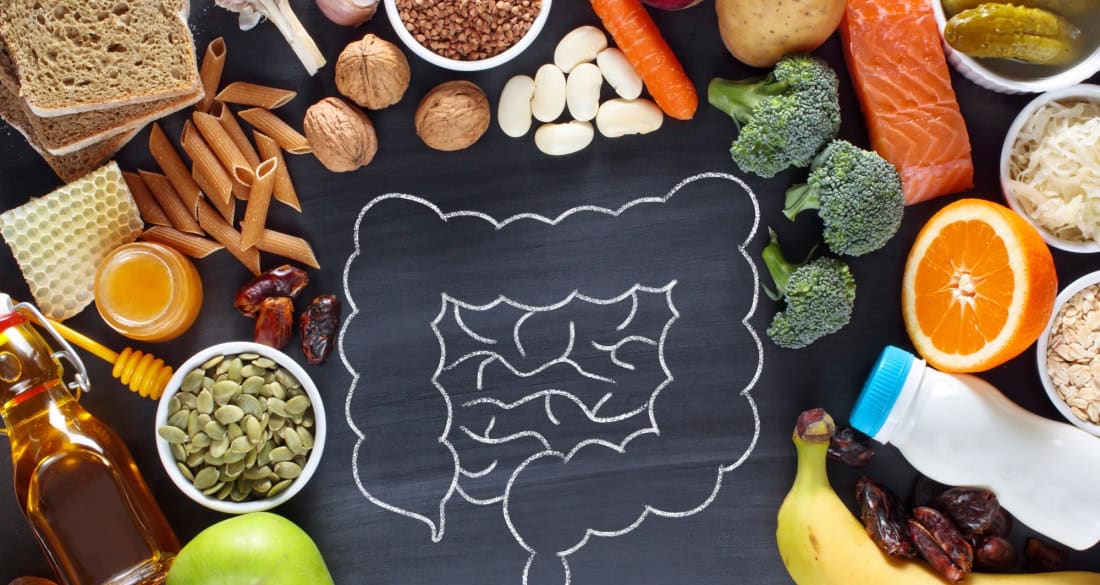
Akkermansia muciniphila does not occur in foods. What diet can influence is the amount of Akkermansia muciniphila naturally present in the gut.
What promotes Akkermansia muciniphila in the gut?
A fibre-rich diet and polyphenols, the plant compounds in pomegranate, green tea and dark berries among others, are associated with higher Akkermansia muciniphila levels in scientific research. Antibiotics have a direct negative effect on the presence of Akkermansia muciniphila. Diet can therefore influence the conditions in the gut, but does not supply Akkermansia muciniphila itself.
Supplementation with pasteurised Akkermansia muciniphila therefore adds something that diet cannot: a standardised, measurable amount of 30 billion pasteurised cells per capsule, with an intact Amuc_1100 protein structure. Where diet influences the background conditions in the gut, a capsule supplies a fixed, standardised amount of pasteurised Akkermansia muciniphila.
Frequently asked questions about Akkermansia muciniphila
Is Akkermansia muciniphila a probiotic?
No. Pasteurised Akkermansia muciniphila contains no live bacteria and therefore does not fall under the definition of a probiotic. EFSA has authorised only pasteurised Akkermansia muciniphila as a safe novel food in the EU. In the scientific literature it is most accurately described as a postbiotic.
Is Akkermansia muciniphila present in food?
No. Akkermansia muciniphila itself is not present in foods. Diet can indirectly influence the presence of Akkermansia muciniphila in the gut, in particular via fibre and polyphenols.
Can I combine Akkermansia muciniphila with probiotics?
Yes. Because pasteurised Akkermansia muciniphila contains no live bacteria, there are no known interactions with live probiotic strains. The two products can be taken at the same time without objection.
What is Amuc_1100 and why is it important?
Amuc_1100 is a protein in the outer membrane of Akkermansia muciniphila and one of the most extensively studied components of the bacterium. Pasteurisation leaves this protein and the structure of the outer membrane intact, so that the protein structure is preserved after pasteurisation. In the EU, only the pasteurised form is permitted.
Do I need to refrigerate Akkermansia muciniphila capsules?
No. Pasteurised Akkermansia muciniphila is stable at room temperature. Refrigeration is not necessary. Store the capsules in a dry place out of direct sunlight.
How long should I take Akkermansia muciniphila?
Clinical studies used periods of 90 days to 24 weeks. One pack contains 30 capsules, enough for one month. We recommend using at least three packs consecutively before you evaluate for yourself.
What is the difference between your Akkermansia muciniphila and that of other brands?
We are transparent about the raw material we use. The metagenomic analysis shows 99.84% purity at species level. We test at four moments through the fermentation process. The Amuc_1100 protein structure remains demonstrably intact after pasteurisation. All batches are encapsulated in our own factory in the Netherlands. The product specification sheet is available for inspection on our product page.
Sources
- Cani, P.D. & de Vos, W.M. (2017). Next-generation beneficial microbes: The case of Akkermansia muciniphila. Frontiers in Microbiology, 8, Article 1765. https://doi.org/10.3389/fmicb.2017.01765
- Depommier, C., Everard, A., Druart, C., et al. (2019). Supplementation with Akkermansia muciniphila in overweight and obese human volunteers: A proof-of-concept exploratory study. Nature Medicine, 25(7), 1096–1103. https://doi.org/10.1038/s41591-019-0495-2
- Desai, M., et al. (2026). Navigating the duality of Akkermansia muciniphila. Nature Microbiology. https://doi.org/10.1038/s41564-025-02222-1
- Mount, S., Canfora, E.E., Jocken, J.W., et al. (2026). Pasteurized Akkermansia muciniphila MucT for weight loss maintenance in people with overweight and obesity: a controlled randomized trial. Nature Medicine. https://doi.org/10.1038/s41591-026-04394-7
- Plovier, H., Everard, A., Druart, C., et al. (2017). A purified membrane protein from Akkermansia muciniphila or the pasteurized bacterium improves metabolism in obese and diabetic mice. Nature Medicine, 23(1), 107–113. https://doi.org/10.1038/nm.4236
Questions about Akkermansia?
Would you like to know more about Akkermansia or do you have questions about your own situation? Our team of nutrition specialists and therapists will be glad to think along with you. Call us on (+31) 070 345 0290 or email info@kalahealth.eu.
A food supplement is not a substitute for a varied, balanced diet and a healthy lifestyle. Consult a qualified professional in case of pregnancy, breastfeeding, use of medication or illness. For legal reasons, we may not publish all information about the effects of this food supplement.
Related Posts