
 Made in the Netherlands
 Free product of your choice with orders over €75,-




MSM GC, MSM GC Plus and MSM GC Vegan. Three product names that mean very…
Why you probably have a mineral deficiency before a vitamin deficiency
Intensive farming has fundamentally changed the mineral content of our food. What this means for your health, and why isolated supplements do not solve the problem.
✓ Written by product developer Paul Klein Breteler ✓ Supported by scientific sources ✓ 25 years of clinical experience
When someone asks me which supplement they should take first, my answer has been the same for many years: make sure your minerals are in order first. Not a multivitamin, not a high dose of vitamin C, not a trending superfood. Minerals first. That advice surprises people. The supplement market is largely driven by vitamins. But there is a fundamental reason why I see the priority the other way around, and that reason has everything to do with what has happened to our agricultural soil over the past hundred years.
“As a population, we do not so much have a vitamin deficiency, but through decades of soil depletion, a mineral deficiency. Replenishing that deficiency is a far more important matter than many people realise.”
What happened to our soil in the last century
The rise of intensive farming has profoundly changed the mineral content of our food crops. American researcher Donald Davis analysed the nutritional composition of 43 vegetables over a fifty-year period using USDA data in 2004. His conclusion: the content of minerals such as calcium, magnesium and iron had declined by several tens of percent on average during that period. Paul Bergner had previously documented an even longer trend going back to 1914, showing that the average mineral content in vegetables declined by a factor of five over the twentieth century.
The cause is structural. Artificial fertiliser returns nitrogen, phosphorus and potassium to the soil: the three elements that make crops grow fastest. Crops therefore grow faster and larger, but absorb qualitatively fewer minerals from a soil that no longer contains them. The remaining 70 minerals and trace elements are removed from the soil harvest after harvest through the crops, but are never replenished. Generations of intensive cultivation have mineralogically depleted the soil.
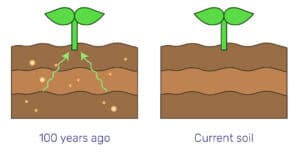
Decline in average mineral content in vegetables in the US from 1914 to 1997. Combined averages of calcium, magnesium and iron in cabbage, lettuce, tomatoes and spinach (Bergner, 1997).
5×
Decline in average mineral content in vegetables, 20th century (Bergner, 1997)
Decline in average mineral content in vegetables, 20th century (Bergner, 1997)
43
Vegetables studied — all with significantly lower mineral content than 50 years earlier (Davis, 2004)
Vegetables studied — all with significantly lower mineral content than 50 years earlier (Davis, 2004)
70+
Minerals and trace elements removed from the soil and never replenished
Minerals and trace elements removed from the soil and never replenished
Why vitamins do not share this problem
The distinction between vitamins and minerals is essential here. Vitamins are largely produced by plants themselves through photosynthesis and metabolic processes. The vitamin content of a plant is therefore less directly dependent on soil quality. A plant growing in depleted soil still produces chlorophyll, carotenoids and ascorbic acid.
Minerals work fundamentally differently. The mineral content in plants is entirely dependent on what is absorbed from the soil through the roots. A plant cannot produce magnesium if the soil contains no magnesium. What is not in the ground does not end up in the crop, and therefore not on the plate.
The core of the problem
Even people who eat a varied and conscious diet are today structurally taking in fewer minerals than was considered normal a generation ago. This has nothing to do with their diet, but with the soil on which their food was grown.
The problem with high-dosing a single mineral
Those who recognise this quickly reach for a magnesium supplement. That is a logical first step, as magnesium is the mineral whose deficiency is most widely documented. But the common approach on the market — one form of magnesium in as high a dose as possible — misses an essential point.
Minerals never operate in isolation. Every mineral influences the absorption, metabolism and excretion of dozens of other minerals. This is not theory: it is a documented biochemical fact, visible in the diagram below.
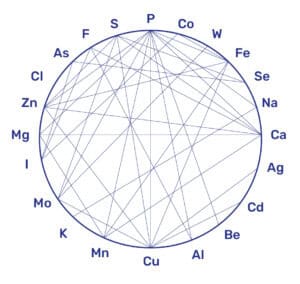
The lines show how minerals and trace elements influence each other’s absorption, metabolism and excretion. The network makes clear why long-term isolated supplementation of a single mineral can disturb the balance (Bergner, 1997).
Two concrete examples from practice illustrate this clearly:
- Zinc and copper: A high intake of zinc suppresses copper absorption. Long-term high-dose zinc without attention to copper can lead to a copper deficiency, even if the diet contains sufficient copper.
- Calcium and magnesium: Calcium and magnesium compete for the same transport proteins in the intestinal wall. A high calcium intake without attention to magnesium balance reduces effective magnesium absorption.
Those who high-dose a single mineral for months without taking the rest into account are shifting the deficiency. They are not solving it. The body is not a sum of individual deficiencies: it is a system in which minerals work together, and that system requires a complete supplement.
Why the order of action matters
A body that is structurally low in minerals can also utilise vitamins less efficiently: many vitamin-dependent enzyme systems require minerals as cofactors to function properly. Establish the foundation first, then everything else.
The most balanced mineral formula we know
Based on this insight, Kala Health developed the Magnesium Complex. The choice of raw material is not arbitrary: seawater concentrate from the Atlantic Ocean. The reason has an evolutionary basis.
The mineral composition of seawater bears a striking physiological resemblance to the extracellular fluid of the human body: the fluid that surrounds every body cell and makes up a fifth of all bodily fluids. Evolutionary biologists see this as indirect evidence that all life forms on land once originated from the sea. This evolutionary kinship makes seawater one of the most complete and physiologically familiar sources of minerals for the human body.
What Aquamin® Mg delivers
The raw material is Aquamin® Mg, sourced from the Atlantic Ocean. One gram delivers 350 mg of elemental magnesium, together with all 75+ minerals and trace elements naturally occurring in seawater, in their natural, mutually balanced proportions. All in ionic form: minerals in ionic form pass through the intestinal wall easily and are therefore efficiently absorbed. No synthetic carrier, no isolated compound, one single ingredient.
What the science says
A study published in January 2026 in the journal Nutrients demonstrated a significantly higher bioavailability of Aquamin® Mg Soluble compared to magnesium bisglycinate when taken together with food (Demehin et al., 2026). Two mechanisms explain this difference: the broad mineral matrix reduces binding by antinutrients such as phytate and oxalate, and the amorphous structure of the seawater concentrate results in faster solubility in the gastrointestinal tract.
The foundation of a serious supplementation approach
The message of this article is not that vitamins are unimportant. The message is that the order of action matters. Establish the foundation first: give the body the complete mineral spectrum that our diet has no longer been providing for decades, in the proportions as nature intended. That is the advice we have given at Kala Health for 25 years, and that is the philosophy behind the Magnesium Complex.
Choose Magnesium Complex Powder if you:
- Want to supplement the complete mineral spectrum rather than a single isolated form of magnesium
- Value a scientifically substantiated choice for bioavailability
- Are looking for a supplement that takes nature as its starting point rather than a synthetic carrier
- Want to establish the foundation of your supplementation before moving on to the rest
75+ minerals and trace elements from seawater concentrate (Aquamin® Mg). 350 mg elemental magnesium per gram. 100% vegan. Produced in our own FSSC 22000-certified facility in the Netherlands.
Frequently asked questions
Why do people more often have a mineral deficiency than a vitamin deficiency?
Vitamins are produced by plants themselves and are still reasonably available through food. The mineral content in plants is entirely dependent on what is absorbed from the soil through the roots. Due to intensive farming and the use of artificial fertilisers, the soil has been mineralogically depleted, causing the mineral content of our food to decline by a factor of five over the twentieth century.
Is a multivitamin not sufficient then?
A multivitamin supplements vitamins, but rarely contains the full spectrum of minerals and trace elements in the correct mutual proportions. Most multivitamins contain a limited number of isolated minerals, often in synthetic form and not in concentrations that meaningfully address a structural mineral deficiency.
Why is high-dosing a single mineral not a good solution?
Minerals do not operate in isolation. Every mineral influences the absorption, metabolism and excretion of dozens of other minerals. Those who high-dose a single mineral long-term without considering the rest are shifting the deficiency rather than solving it. A high zinc intake suppresses copper absorption; a high calcium intake competes with magnesium for the same transport proteins in the intestinal wall.
Why is seawater concentrate a good source of minerals?
The mineral composition of seawater bears a striking physiological resemblance to the extracellular fluid of the human body. Seawater contains all 75+ minerals and trace elements in their natural proportions and in ionic form, making them directly absorbable by the intestinal wall.
Is seawater magnesium better absorbed than magnesium bisglycinate?
A published in vitro study in Nutrients (2026) demonstrated significantly higher bioavailability of Aquamin® Mg Soluble compared to magnesium bisglycinate when taken together with food. This concerns laboratory research using a validated cell model; additional human clinical studies are needed for definitive conclusions.
Who is Magnesium Complex Powder suitable for?
The product was developed for everyone who wants to supplement their daily diet with a complete mineral complex rather than isolated magnesium. It is 100% vegan and free from yeast, lactose and gluten. During pregnancy, breastfeeding, medication use or illness, it is advisable to consult a specialist first.
References
- Bergner, P. (1997). The healing power of minerals, special nutrients, and trace elements. Prima Publishing.
- Davis, D.R., Epp, M.D., & Riordan, H.D. (2004). Changes in USDA Food Composition Data for 43 Garden Crops, 1950 to 1999. HortScience, 39(6), 1248–1254.
- Demehin, O.A., Ryan, M., Higgins, T., Moura Motta, B., Jähnichen, T., & O’Connell, S. (2026). A comparison of marine and non-marine magnesium sources for bioavailability and modulation of TRPM6/TRPM7 gene expression in a Caco-2 epithelial cell model. Nutrients, 18(2), 324. https://doi.org/10.3390/nu18020324
Please note: A food supplement is not a substitute for a varied, balanced diet and a healthy lifestyle. Consult a specialist before use during pregnancy, breastfeeding, medication use or illness.
Written by Paul Klein Breteler, PhD
Product developer & founder Kala Health
About Kala Health
Kala Health was founded in 1997 by Paul Klein Breteler. Since then, he has been formulating his own supplements, treating clients and advising on nutrition and supplementation. That combination of developing, producing and advising has always been the core of Kala Health. We now work with a team of nutrition specialists, an in-house therapist and a pharmacist, all from our FSSC 22000-certified facility in the Netherlands.
All products are purchased, tested and produced by us. That gives us control over every step of the process and enables us to be transparent about exactly what is in a capsule and how it was made.
Questions about Magnesium Complex?
Would you like to know more about the Magnesium Complex or do you have questions about your own situation? Our team of nutrition specialists and therapists is happy to help. Call us on (+31) 070 345 0290 or email info@kalahealth.eu.
Related Posts